CGN World Brief: David Attenborough at 100 and the Voice That Taught the World to Look at Nature
As Sir David Attenborough reaches his 100th birthday, his career stands as one of broadcasting’s
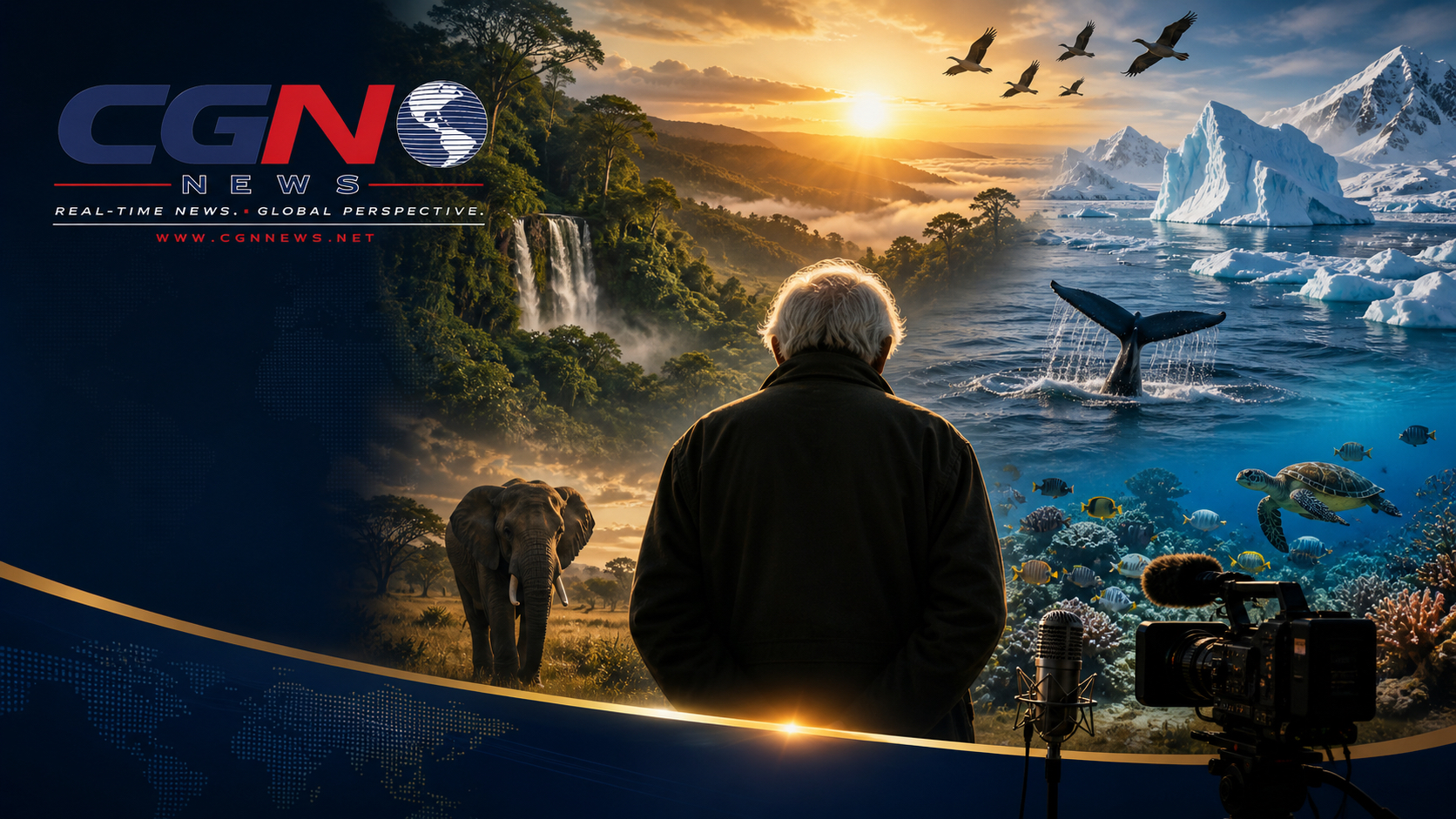
LONDON | Sir David Attenborough turns 100 on 8 May 2026, closing one century of life and more than seven decades of work that helped change how millions of people understand the natural world.
For many viewers, Attenborough is not simply a broadcaster. He is the voice that taught generations to pause, watch, listen and take seriously the life moving beyond the edge of human attention. His documentaries brought forests, oceans, deserts, mountains, coral reefs, polar ice and endangered species into homes around the world, often with a tone that made science feel personal without making it sentimental.
His birthday is being marked in Britain with special BBC programming, public events, museum activities, nature walks, tree planting and a live celebration at the Royal Albert Hall. The scale of the tribute reflects a rare kind of public standing. Attenborough’s career is not remembered only for a single program, era or format. It is remembered as a long public service to natural history, broadcasting and environmental awareness.
Born in Isleworth, London, in 1926, Attenborough grew up with a child’s fascination for fossils, insects and the physical evidence of life. That curiosity became the organizing force of one of the most significant broadcasting careers of the modern age. His early television work with the BBC began in the 1950s, when natural-history programming was still a developing form and television itself had not yet become the global medium it is today.
His first major breakthrough came through programs that sent him into distant environments and introduced audiences to animals, landscapes and scientific questions that had rarely been presented with such immediacy on television. Later, after rising into senior leadership at the BBC, he made the defining choice to return to program-making rather than remain behind a desk. That decision helped produce the work that made him a household name.
In 1979, Life on Earth gave television audiences a sweeping account of evolution and the living world. The series required years of travel and production, and it helped establish a model for ambitious natural-history television that would be expanded through later landmark series. Attenborough’s work showed that scientific subjects could be presented with scale, seriousness and drama without abandoning accuracy.
What made his style endure was not only the locations or the technology. It was the trust created by the voice itself. Attenborough could describe the mechanics of a hunt, the delicacy of a pollination cycle, the vulnerability of a species or the hidden order of an ecosystem without turning the subject into spectacle alone. He gave the viewer permission to be amazed, but he also asked the viewer to understand.
Across the decades, scenes from his work became part of the shared memory of nature broadcasting. His encounter with mountain gorillas during Life on Earth showed an intimacy between human observer and wild animal that television viewers had rarely seen. Later programs revealed the intelligence and coordination of orcas, the scale of ocean life, the fragility of polar habitats and the disappearance of species whose decline could no longer be treated as distant or abstract.
One of the most powerful examples was the story of Lonesome George, the last known Pinta Island tortoise. His death marked the end of a species, and Attenborough’s treatment of that story helped viewers feel extinction not as a statistic but as a final silence. That has been one of his great contributions: he turned environmental loss into something audiences could understand emotionally while still grounding the message in the reality of biology and habitat.
As climate change, plastic pollution and biodiversity loss became more visible public concerns, Attenborough’s work grew more direct. His later documentaries did not simply celebrate nature. They warned that the systems supporting life were under pressure from human activity, pollution, overconsumption, warming oceans and disappearing habitats.
Blue Planet II, released in 2017, became one of the clearest examples of that shift. Its treatment of plastic pollution helped move ocean waste from an environmental concern into a mainstream public issue. Images of marine life affected by plastic entered public debate in Britain and beyond, adding pressure on governments, companies and consumers to confront the consequences of disposable materials.
That influence is one reason Attenborough’s 100th birthday is more than a cultural milestone. It is also a moment to measure how public understanding of the environment has changed during his lifetime. When he began working in television, nature programming often focused on discovery and wonder. By the later decades of his career, the same genre had become inseparable from questions of survival, responsibility and public policy.
Attenborough’s public reputation has been strengthened by the way he carries authority. He is admired by political leaders, artists, scientists, viewers and younger generations, but he has often resisted celebrity language around his own life. Those who have worked with him frequently describe someone driven less by fame than by the work itself: the explanation, the image, the animal, the story and the chance to make people care.
That public-service instinct matters. In an age when attention is fragmented and trust in media is often strained, Attenborough remains one of the few figures whose voice can still gather an audience around a shared subject. He does not need to shout. His authority comes from patience, consistency and an almost old-fashioned belief that the natural world is worth careful explanation.
His career also tracks the technical evolution of documentary television. The world he first filmed was captured with limited equipment, slower production methods and far less access to remote environments. Today, natural-history programming uses drones, high-definition cameras, satellite data, underwater systems, remote sensors and advanced editing tools. Attenborough’s work spans that entire transformation.
But the deeper change is not merely technological. It is moral and civic. The same planet that television learned to film more beautifully has become more visibly strained. Coral reefs are bleaching. Ice is melting. Species are being pushed toward extinction. Extreme weather is becoming more disruptive. Forests, wetlands, oceans and grasslands are all part of political and economic debates that can no longer be separated from everyday life.
That is why Attenborough’s legacy belongs not only to the BBC or to British culture. It belongs to a global conversation about whether knowledge produces responsibility. He helped viewers see that nature is not a decorative background to human affairs. It is the living system beneath food, water, climate, health, migration, security and economic stability.
The centenary celebrations in Britain are expected to highlight both the joy and the seriousness of that career. The BBC is marking the occasion with special programming, including new and retrospective work, while public events are giving audiences a chance to connect Attenborough’s life to broader questions about conservation and the future of the planet.
At 99 and entering his 100th year, Attenborough has remained involved in new work. That fact gives the milestone an unusual force. This is not only a retirement tribute or a look backward at a completed career. It is a tribute to a person who has continued to work, warn, explain and participate in public life while many of the environmental risks he described have become more urgent.
His life also reminds viewers that storytelling can shape public behavior. Scientific reports matter. Government policy matters. Conservation work matters. But public imagination matters too. People are more likely to protect what they have learned to notice. Attenborough’s career helped make noticing a civic act.
For CGN News readers, the lesson of Attenborough at 100 is not only that one broadcaster achieved extraordinary longevity. It is that trust, clarity and restraint can still carry power. He built a career by refusing to treat the audience as shallow. He assumed viewers could understand complexity if it was shown clearly. He assumed wonder and evidence could stand together.
That may be the most important part of his legacy. David Attenborough did not merely narrate the natural world. He helped teach the world how to look at it. As he reaches 100, the question his work leaves behind is whether humanity can look closely enough, and act quickly enough, to protect the life he spent a century helping us see.
Additional Reporting By: Reuters; Britannica; BBC News; Royal Albert Hall public event information
What this means
Sir David Attenborough’s 100th birthday is a global cultural moment because his career helped move environmental awareness from specialist science into everyday public life. Through television, narration and decades of careful storytelling, he made the natural world understandable to audiences that may never visit the places his programs showed.
The larger issue is whether public awareness can become public responsibility. Attenborough’s work helped generations see the beauty and fragility of nature. The next test is whether governments, companies and citizens respond to climate pressure, pollution, habitat loss and extinction with the same seriousness that his documentaries asked viewers to bring to the screen.